AI in 2026: What People Thought Would Change — and What Refused To Between hype, fear, and reality: how society, especially the younger generation, is actually experiencing AI
- OLIVE SEEDS DIGITAL DESIGN STUDIO 🫒
- Jan 5
- 3 min read

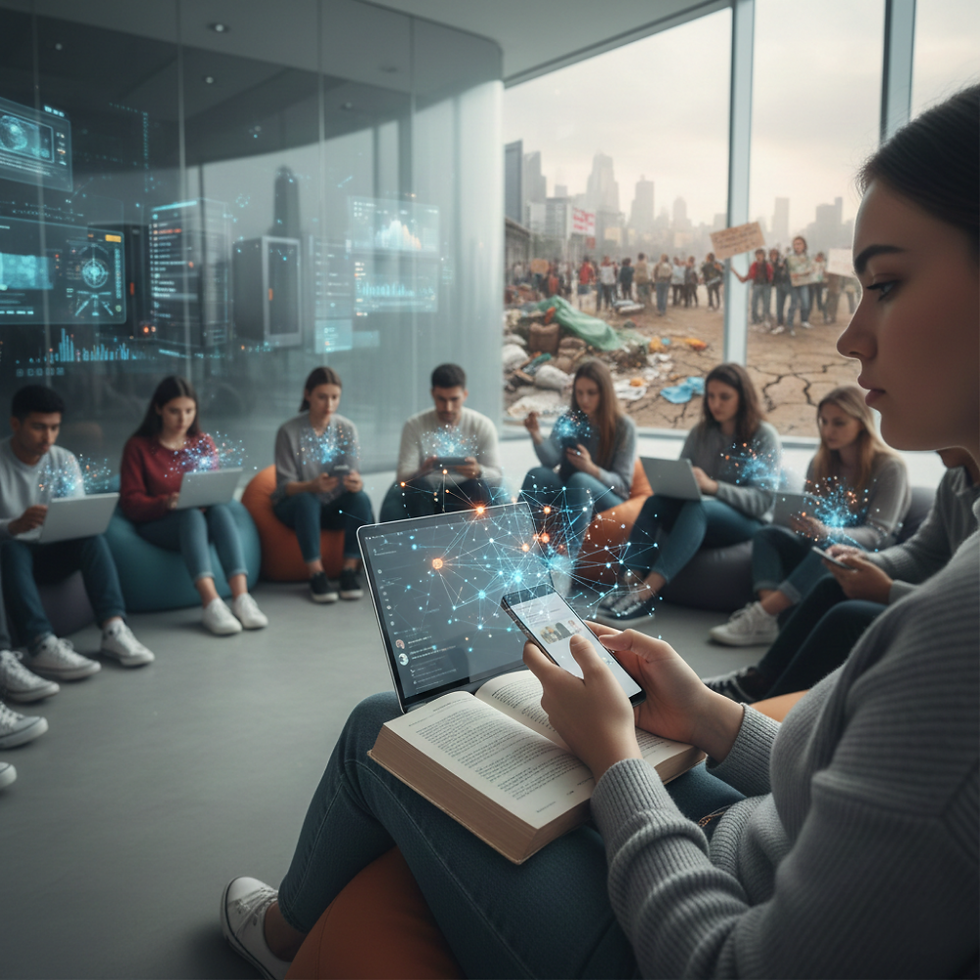
Introduction: This Is Not a Tech Blog — It’s a Social Mirror
By 2026, artificial intelligence is no longer a future concept. It’s not a keynote topic. It’s not a lab experiment. It’s daily life.
But here’s the uncomfortable truth most tech narratives avoid:
AI didn’t change humanity as much as humanity exposed itself through AI.
This blog is not written from a technical lens. It is built from conversations — scattered across social media, casual debates, comment sections, podcasts, and informal discussions with young people who are not from tech backgrounds. These are people consuming AI, reacting to AI, and living alongside it without ever reading a white paper.
Their thoughts are shaped less by code and more by culture, environment, fear, war, religion, inequality, and survival.
And one name keeps coming up in those conversations.
Elon Musk.
Section 1: The Elon Musk Effect — Vision Heard, Reality Questioned
When Elon Musk talks about AI, people listen. Not because they understand the technical depth — but because he frames AI as existential.
Across social platforms, young people repeatedly reference his interviews:
“AI will surpass human intelligence.”
“AI could be the most dangerous invention.”
“AI could solve everything — or end everything.”
But here’s the key observation from public conversations:
> People don’t reject his vision — they doubt its timing, its reach, and its relevance to their real lives.
In comment threads and casual discussions, a common sentiment appears:
“Maybe AI will change the world, but not my neighborhood.”
“It won’t stop wars.”
“It won’t fix religion.”
“It won’t change who controls power.”
To them, Musk’s vision sounds global, theoretical, and delayed. Their lives are immediate.
AI might answer questions faster — but it doesn’t answer why the world still feels unstable.
Section 2: The Younger Generation’s View — Practical, Not Philosophical
One critical mistake analysts make is assuming young people are blindly optimistic about AI.
They aren’t.
They are transactional.
From social media conversations:
AI is useful for learning faster.
AI is good for content creation.
AI helps with productivity.
AI feels like a shortcut — not a savior.
But they draw a sharp line.
> AI changes tools. It does not change power structures.
Young people consistently point out:
AI won’t reduce rent.
AI won’t stop geopolitical conflicts.
AI won’t erase class differences.
AI won’t fix environmental damage caused by decades of human decisions.
They don’t fear AI dominance.
They fear human misuse of AI.
That’s a critical distinction most futurists ignore.
Section 3: Social Media as the Real AI Classroom
Forget universities.
Forget conferences.
Social media is where AI opinions are actually formed.
TikTok, X, Reddit, Instagram — these platforms are filled with:
Short clips of Musk interviews
Reaction videos
Skeptical takes
Sarcastic memes
Real-life comparisons
A recurring theme appears in comments:
> “AI feels advanced, but life feels the same.”
People notice the contradiction:
AI-generated art is stunning — yet artists are struggling.
AI writes code — yet jobs feel less secure.
AI predicts trends — yet society feels directionless.
This isn’t ignorance.
It’s pattern recognition.
Section 4: Two Decades Ago vs Now — What Actually Changed
20 Years Ago (2006):
AI was invisible.
Automation was limited.
The internet was optimistic.
Tech felt empowering.
Fear was minimal.
Now (2026):
AI is everywhere.
Automation is aggressive.
The internet is polarized.
Tech feels extractive.
Fear is normalized.
The shift isn’t technological — it’s emotional.
People don’t distrust AI because it’s powerful.
They distrust it because trust in institutions collapsed.
Section 5: What AI Can’t Change — And People Know It
From repeated public conversations, certain beliefs are consistent:
AI cannot:
End war driven by ideology.
Neutralize religious extremism.
Eliminate inequality rooted in history.
Replace human accountability.
Fix broken governance.
People aren’t naïve.
They’re realistic.
They see AI as an amplifier, not a healer.
If the system is broken, AI scales the broken system faster.
---
Section 6: The Next 10 Years — Hope Without Illusion
Looking ahead, public sentiment is cautious — not dystopian.
People expect:
Smarter tools
Faster workflows
More automation
More surveillance
More dependency
But not transformation of human nature.
The dominant belief is this:
> The future won’t be decided by AI intelligence — but by human intent.
And right now, that intent looks fragmented.
Conclusion: Back to the Future — Same Questions, Better Machines
In 2026, AI didn’t redefine humanity.
It forced a confrontation with an old truth:
Technology evolves faster than wisdom.
Power concentrates faster than fairness.
Tools advance faster than ethics.
The conversations happening online — especially among young, non-technical voices — are not anti-AI.
They are anti-illusion.
They don’t ask:
> “What can AI do?”
They ask:
“Who controls it — and why should we trust them?”
Until that question is answered honestly, AI will remain impressive, useful, and deeply insufficient to change the world people actually live in.
Contact Olive seeds for your design


Comments